






About Our Facility
The Portage Lake Water & Sewage Authority (PLWSA) was established in 1964 by the cities of Hancock and Houghton for the purpose of constructing and operating a joint use wastewater treatment facility. The facilities that were constructed included a lift station for each city to convey wastewater to a common site and a wastewater treatment plant located on the south shore of Hancock.
Planning was initiated by the PLWSA in 1987 when it became evident that the existing treatment plant was operating at flows in excess of the design flow and was not able to treat all of the excess flow that was being generated by both cities.
TKDA and U.P. Engineers and Architects were retained to prepare a facility plan to determine the rehabilitation and possible expansion necessary to provide treatment of all the wastewater flow generated by the two communities. The State DNR established the criteria that all the wastewater generated must receive treatment to meet the effluent plant limits.
 |
|
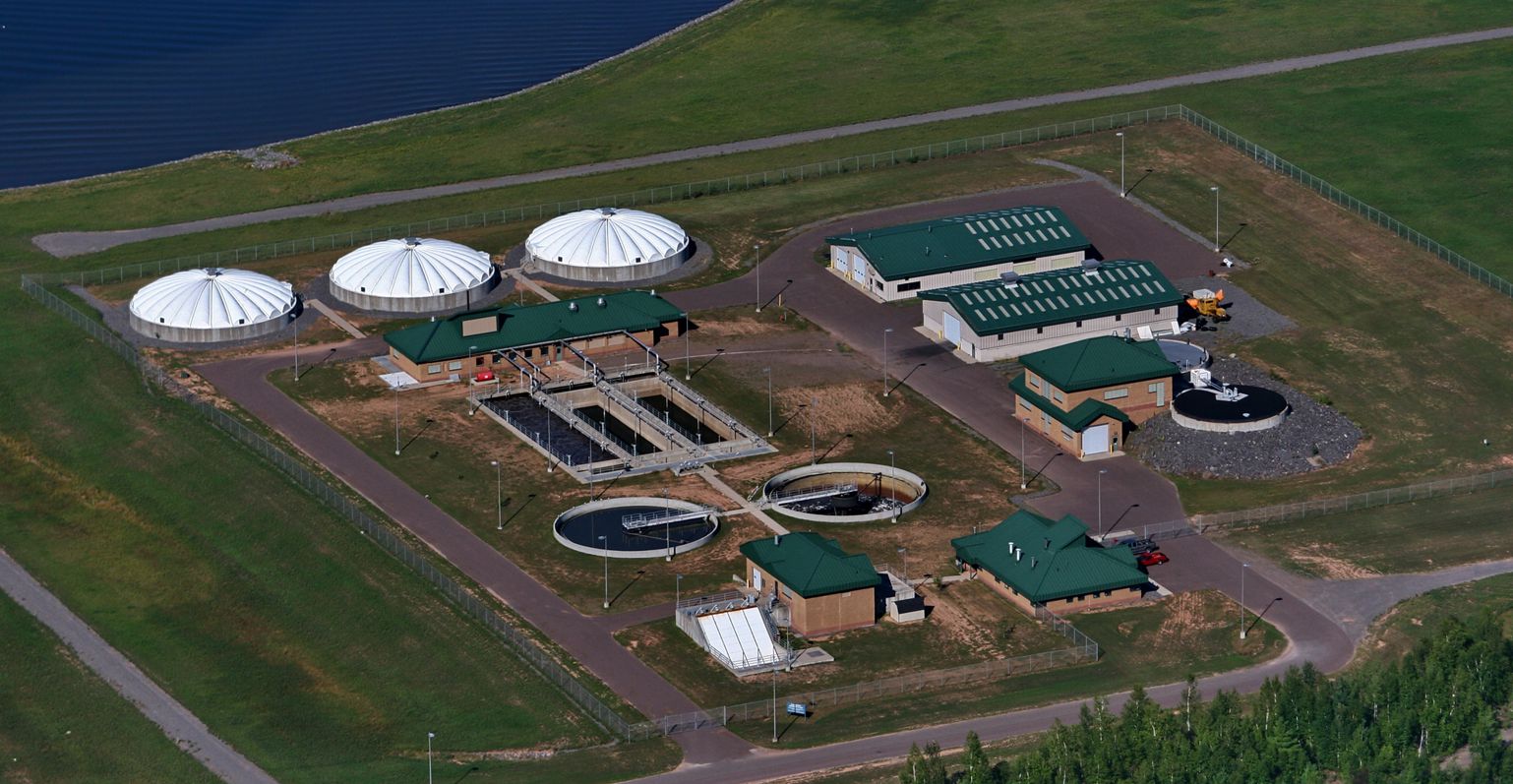
Photo description: PLWSA Wastewater Treatment Plant |
The facility plan determined that the most cost effective and environmentally sound long-term plan was to construct a new treatment facility on the Houghton sands site. Construction of this facility was completed and placed into operation in 1993. The treatment plant has a design flow of 3.1 MGD with a capacity to treat 18 MGD during wet periods of snowmelt and rainfall.
Wastewater Conveyance
Components
The Hancock lift station at the
old treatment plant site was remodeled twice since the new plant
was built. The latest remodel was to install new pumps and
variable frequency controls at the lift station and also to
construct a new 16” forcemain, which runs through Ripley, MI,
along the snowmobile trail and crosses the Portage Canal to
discharge Hancock’s sewage into the gravity interceptor. The
Houghton lift station was remodeled and a 24” forcemain was
constructed to convey W. Houghton’s sewage to the gravity
Interceptor. The Interceptor collects all of the lift station
flows and any remaining gravity flows and conveys it to the
treatment plant.
Influent Pumping
Wastewater that arrives at the treatment plan is lifted by screw
pumps through the treatment units and to Portage Lake.
Pretreatment
Pretreatment consists of screening and grit removal. The
mechanically cleaned bar screen removes coarse solids from the
flow. The aerated grit chambers remove sand, gravel and heavy
grit to protect the downstream treatment units.
Primary Clarification
The primary clarifiers remove a significant portion of the
suspended solids from the wastewater. These tanks allow solids
to settle slowly to the bottom of the tank by gravity. Settled
solids are collected at the bottom of the tanks and pumped as
"sludge" to the anaerobic digestors.
Secondary Treatment
(Activated Sludge)
Secondary treatment is a biological
process that is used to remove organic material present in the
wastewater. The biological process utilized is called activated
sludge. Aerobic (oxygen-demanding) bacteria grow in these
tanks and consume the organic materials in the wastewater. This
process is accomplished in the secondary aeration tanks and the
secondary clarifiers. After aeration, the bacteria-laden solids
are separated in the secondary clarifiers and a portion is
returned to the aeration tank. This arrangment of "return
sludge" allows the operator to control the amount of bacteria
present in the process. Excess solids are wasted to the primary
clarifiers where it is combined with the primary solids.
Disinfection
Ultraviolet (UV) disinfection is the final treatment of the
wastewater. Disinfection is accomplished by an innovative
process that utilizes high dosages of ultraviolet light to
eliminate any potentially harmful pathogenic organisms that
could be present in the wastewater. A specific wavelength of
ultraviolet light is germicidal and is used to destroy nearly
all of the bacteria that are present.
Discharge
An
underground pipeline carries the treated effluent to a
100-foot-long submerged diffuser for discharge into Portage
Lake.
Anaerobic Digestion
Anaerobic digesters process the sludge removed from the
clarifiers to produce methane gas and biosolids
fertilizer. The Primary Digester is heated and mixed to foster
the growth of anaerobic methanogenic bacteria. The Secondary
digester is a quiescent basin which allows the biosolids to
separate from the liquid as it settles. Anaerobic digestion
converts most of the organic material in the sludge to biogas,
comprised mainly of methane and carbon dioxide, and produces
biosolids that have a significant fertilizer value which can be
used as a soil amendment to promote vegetative growth.
Biosolids Dewatering
and Storage
The biosolids are dewatered
by belt filter presses to a moist state containing about 16%
solid material by weight. The dewatering step removes water and
reduces the volume to be hauled to land application. A storage
facility provides storage of dewatered biosolids between periods
of land application.
Land Application of
Biosolids Fertilizer
The processed biosolids are
applied as a soil amendment with a fertilizer value to area hay
fields to assist in plant growth. The biosolids are also applied
to the Mason stamp sands site, one of the area’s mine tailings
sites, to help maintain the plant growth. As a former Superfund
site, the Mason stamp sands site was capped with a sandy loam
soil and seeded with vegetation in 2004. The PLWSA has been
applying biosolids onto the Mason site since 1968.
The Portage Lake Water & Sewage Authority
(PLWSA) was
established in 1964...
by the cities of Hancock and Houghton for the purpose of constructing and operating a joint use wastewater treatment facility. The facilities that were constructed included a lift station for each city to convey wastewater to a common site and a wastewater treatment plant located on the south shore of Hancock.
Planning was initiated by the PLWSA in 1987 when it became evident that the existing treatment plant was operating at flows in excess of the design flow and was not able to treat all of the excess flow that was being generated by both cities.
TKDA and U.P. Engineers and Architects were retained to prepare a facility plan to determine the rehabilitation and possible expansion necessary to provide treatment of all the wastewater flow generated by the two communities.